Timer Psychology Explained
Understand the psychological science that makes countdown timers so powerful in email marketing.
Create Your Timer — Free 10,000 free impressions a month · No watermark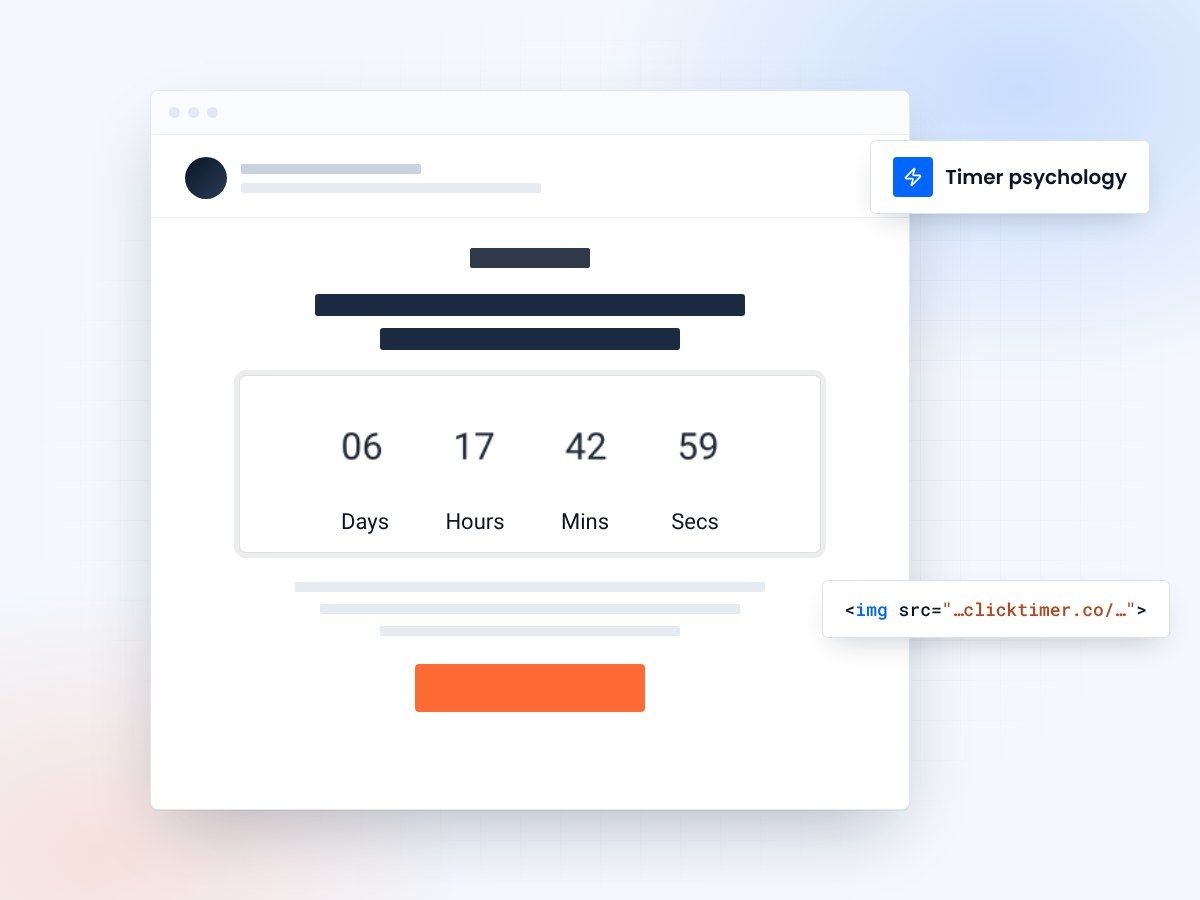
- Loss aversion, made visible
- Real deadlines, real urgency
- 10,000 free impressions a month
- No watermark, even on the free plan
Why countdown timers work
Countdown timers work because they leverage fundamental psychological principles identified by behavioral economists and psychologists. Understanding these principles helps you implement timers more effectively and predict their impact on audience behavior.
- Countdown timers increase email engagement by creating urgency
- Visual timers improve click-through rates and conversions
- Time-sensitive messaging drives immediate action
Loss aversion: the engine behind the timer
Losses weigh twice as much
Nobel Prize-winning psychologist Daniel Kahneman's research revealed that people are approximately twice as motivated by potential losses as by potential gains. This is loss aversion: we feel the pain of loss more intensely than the pleasure of equivalent gain.
The timer frames a loss
A countdown timer frames the situation as a potential loss: "If I don't act, I'll miss this opportunity." This loss-framing is far more motivating than gain-framing would be. A message saying "You could save $50" (gain frame) is less motivating than "You'll miss saving $50" (loss frame), even though mathematically they're identical.
Every second makes it concrete
Countdown timers make potential loss concrete and salient. As the timer counts down, subscribers visualize the loss: "Every second, I'm closer to missing this deal." This visualization amplifies loss aversion, creating strong motivation to act.
Create your countdown
Put a real deadline in front of your subscribers. 10,000 free impressions a month, no credit card.
Already have an account?
Send Test Email
Enter your email to receive a preview of how this countdown looks in email campaigns.
Impact metrics
| Metric | Impact | Result |
|---|---|---|
| Email open rates | Countdown timers in subject lines | ↑ 25-40% |
| Click-through rates | Visual timer elements in content | ↑ 18-35% |
| Conversion rates | Urgency-driven messaging | ↑ 12-30% |
| Customer action speed | Limited-time offers | 3x faster |
Do and don't
Do
- Use realistic, achievable deadlines
- Make timers visually prominent
- Test countdown copy variations
- Update timers in follow-up emails
Don't
- Use fake countdown timers
- Overuse urgency messaging
- Hide expiration dates
- Forget to honor deadlines
Frequently asked questions
How do countdown timers affect email deliverability?
Countdown timers don't directly impact deliverability. However, ensure your timer code is clean HTML/CSS and avoid heavy JavaScript that could trigger spam filters. Test emails with major providers before sending.
Should I use the same deadline for all recipients?
Segmentation is recommended. Send time-zone adjusted emails with recipient-specific deadlines for maximum relevance. This prevents last-minute send volume spikes.
What's the optimal countdown duration?
24-72 hours is typically ideal for urgency without creating undue pressure. Test different durations with your audience to find the sweet spot.
How do I ensure timer accuracy across clients?
Use server-side rendering or dynamic content blocks that calculate time differences server-side. This ensures consistency across all email clients, from Gmail to Outlook.
Start driving urgency-based conversions today
Create your first countdown timer in 30 seconds and start driving urgency-based conversions today.